Is Stalwart Better Than Zimbra? A Security-Focused Comparison
Stalwart or Zimbra? A security-focused comparison of architecture, exploitation history, licensing and cost, with a clear verdict on which self-hosted mail server to run in 2026.

Key takeaways
- For most new self-hosted deployments, Stalwart is the stronger choice on security, operational simplicity and cost.
- Stalwart is written in Rust and ships as a single signed binary, which reduces both attack surface and patching complexity.
- Zimbra is a frequent target of real attacks. Several of its flaws have been added to CISA KEV across 2025–2026, including CVE-2026-73570, which led to over 270 compromised servers.
- Zimbra no longer provides free official binaries for current versions. Open Source Edition users must build from source or trust community builds, which raises supply-chain and patch-assurance concerns under PCI DSS and SOC 2.
- Stalwart includes SPF, DKIM, DMARC, ARC, MTA-STS, DANE and ACME out of the box. Zimbra needs add-ons or manual work for several of these.
- Zimbra still leads on groupware: its mature web client, MAPI for Outlook and ActiveSync support (Network Edition) remain its strongest arguments.
- Whichever platform you choose, your ability to patch, monitor and harden it matters more than the product itself.
On this page
- Overview of the two platforms
- Architecture and technology stack
- Stalwart vs Zimbra: Security comparison
- Memory safety and code base
- Exploitation history
- Authentication and access control
- Transport and data protection
- Email authentication and anti-spam
- Risk considerations
- Features, protocols and collaboration
- Operations, scalability, licensing and cost
- Operations and scalability
- Licensing
- Practical implication
- Stalwart vs Zimbra: Side-by-side comparison
- Verdict: is Stalwart better than Zimbra?
- If you are migrating from Zimbra to Stalwart
- If you are staying on Zimbra
In the Stalwart vs Zimbra decision, Stalwart is the stronger technical and security choice for most organisations self-hosting email in 2026. Zimbra remains the safer option only where a mature, Outlook-style groupware suite and established commercial support are non-negotiable.
Email remains the most targeted entry point into an enterprise. The mail server you choose determines your attack surface, your patching burden, and how easily you can enforce modern authentication and transport security. That makes the choice a security architecture decision, not just an IT procurement one.
Whether you are a security architect, system administrator, IT manager or managed service provider, this Stalwart vs Zimbra comparison covers architecture, security, features, operations and licensing, and ends with a clear recommendation for your deployment. Share your setup or questions in the comments, I am happy to help, and pass this guide on to your team.
Overview of the two platforms
Stalwart is a modern mail and collaboration server written in Rust and developed by Stalwart Labs. It ships as a single binary that bundles SMTP, IMAP, JMAP, POP3, CalDAV, CardDAV, WebDAV, a spam filter and a web admin console. Refer the Stalwart release.
Zimbra Collaboration (ZCS) is a long-established email and groupware suite, now owned by Synacor. It offers mail, calendar, contacts, tasks and file sharing through a feature-rich web client. It comes in two editions: the Open Source Edition (OSE) and the commercial Network Edition, which adds closed-source components such as ActiveSync and an Outlook (MAPI) connector. The current line is 10.1.x.
The key difference is generational. Stalwart is a clean-sheet design built around modern protocols and memory safety. Zimbra is a mature suite whose architecture dates back to the mid-2000s.
Architecture and technology stack
Stalwart has the simpler and smaller architecture, which directly reduces attack surface and operational risk.
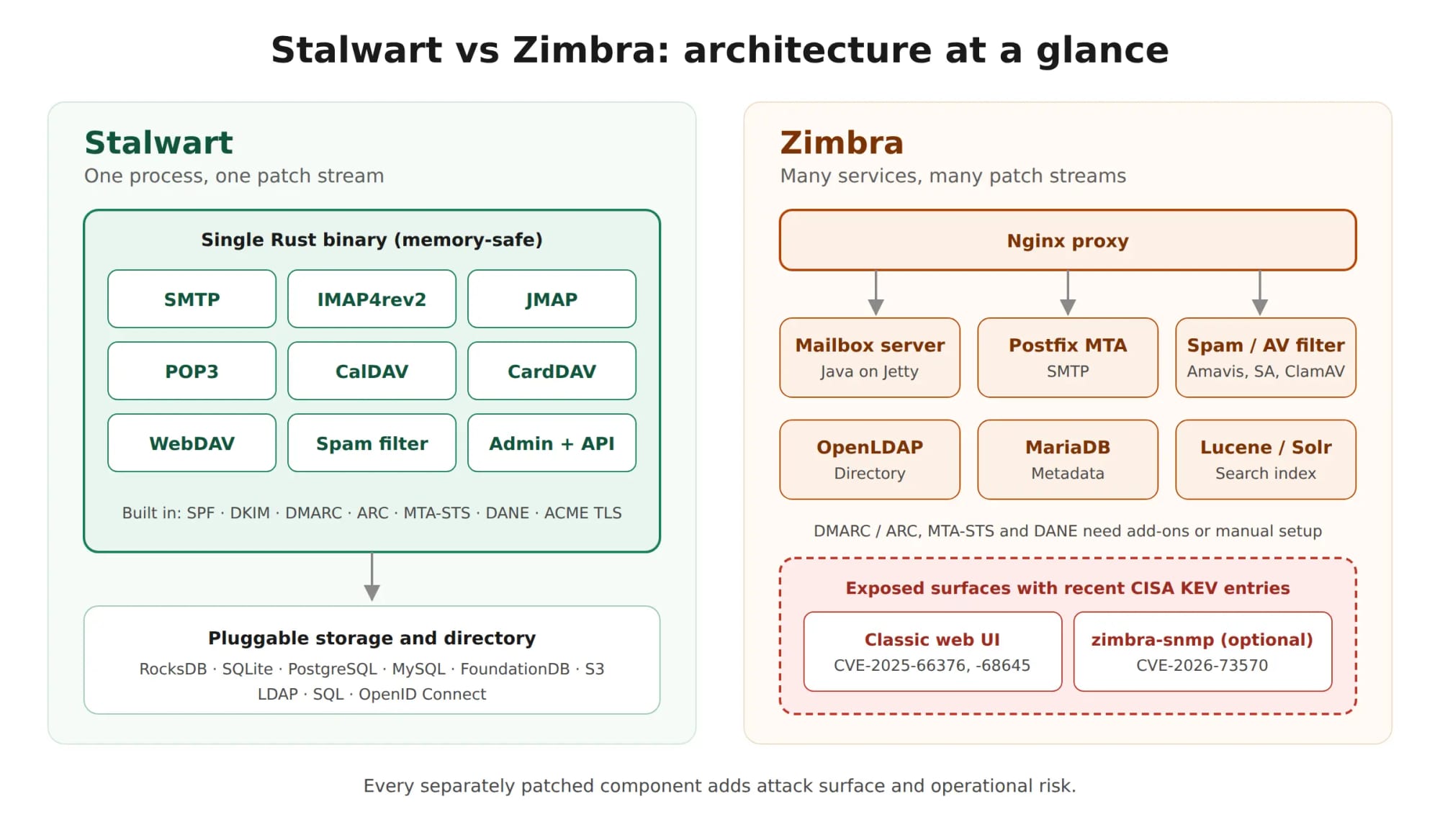
Stalwart runs every protocol in one Rust process. Storage is pluggable: RocksDB or SQLite for small deployments, and PostgreSQL, MySQL, FoundationDB, S3-compatible object storage or Redis for larger, clustered ones. Directory integration supports LDAP, SQL and OpenID Connect. Fewer moving parts means fewer services to harden, patch and monitor.
Zimbra is a composition of many components: a Java mailbox server on Jetty, Postfix for the MTA, OpenLDAP for the directory, MariaDB for metadata, Nginx as the proxy, Amavis with SpamAssassin and ClamAV for content filtering, and Lucene/Solr for indexing. Each component carries its own patch cycle and its own CVE stream, and Zimbra must ship coordinated updates across all of them.
From a security architecture standpoint, this matters. Every additional daemon, interpreter and inter-process interface is another place for misconfiguration, privilege escalation or exploitation to occur.
Stalwart vs Zimbra: Security comparison
On security posture, Stalwart has a clear structural advantage, and Zimbra's recent exploitation record reinforces it.
Memory safety and code base
Stalwart is written in Rust, which eliminates whole classes of memory-corruption bugs such as buffer overflows and use-after-free at compile time. Zimbra relies on Java plus a large set of C, Perl and PHP-adjacent components, including a legacy JSP-based Classic web UI. Rust does not prevent logic flaws, injection or authorisation bugs, so it is a risk reduction, not a guarantee.
Exploitation history
Zimbra is a recurring target for both criminal groups and state-sponsored actors, largely through its webmail layer. Recent examples:
Vulnerability | Type | Status |
|---|---|---|
Command injection to RCE via optional zimbra-snmp package; fixed in 10.1.20 | Added to CISA KEV on 21 August 2026; over 270 instances found compromised | |
Stored XSS in Classic UI via CSS @import in email HTML | CISA KEV; used to deliver email-harvesting JavaScript | |
Unauthenticated local file inclusion in the RestFilter servlet (/h/rest) | Added to CISA KEV in January 2026; public PoC available |
These are not isolated incidents. APT28 and Winter Vivern have both used Zimbra XSS flaws to steal mail from government and NATO-aligned targets. Stalwart, being newer and less widely deployed, has a much shorter history and has not appeared in the KEV catalogue. That reflects both a smaller attack surface and less attacker attention, so treat it as encouraging rather than conclusive.
Authentication and access control
Stalwart provides built-in TOTP two-factor authentication, app-specific passwords, OAuth 2.0/OpenID Connect, role-based access control and automatic brute-force and fail2ban-style IP blocking. Zimbra offers 2FA and SAML/SSO, but several of these capabilities sit in the Network Edition rather than the Open Source Edition.
Transport and data protection
Stalwart includes native ACME for automatic TLS certificates, MTA-STS, DANE, TLS reporting, and optional encryption at rest using S/MIME or OpenPGP keys supplied by the user. Zimbra supports TLS, S/MIME (Network Edition) and DKIM, but MTA-STS and DANE typically require manual work around its bundled Postfix.
Email authentication and anti-spam
Stalwart natively implements SPF, DKIM, DMARC and ARC, generates the DNS records for you, and includes a built-in spam and phishing filter with optional LLM-assisted analysis. Zimbra relies on Amavis, SpamAssassin and ClamAV, which are proven but heavier, and DMARC/ARC handling usually needs additional components such as OpenDMARC.
Risk considerations
Zimbra: high-value target with a steady flow of actively exploited flaws. Patch velocity is essential, and Open Source Edition users depend on community builds for fixed binaries.
Stalwart: a smaller, younger project. Key risks are vendor concentration, a pre-1.0 version number and less third-party security research coverage. Pin versions and verify the Sigstore signatures shipped with each release.
Features, protocols and collaboration
Zimbra still leads on end-user groupware experience; Stalwart leads on protocol modernity.
Where Zimbra is stronger:
A mature, all-in-one web client with mail, shared calendars, contacts, tasks, briefcase and delegation.
Outlook integration via MAPI and mobile sync via ActiveSync (Network Edition).
A long track record in hosting providers, universities and government, with established migration tooling and partners.
Where Stalwart is stronger:
First-class JMAP support for mail, calendars and contacts, alongside IMAP4rev2, POP3, CalDAV, CardDAV and WebDAV.
Full Sieve scripting with registered extensions for server-side filtering.
Full-text search in 17 languages without a separate search cluster.
A built-in web admin console and REST API that suit automation and infrastructure-as-code.
The main gap for Stalwart is the end-user web experience. Organisations have traditionally paired it with a separate webmail client such as Roundcube or SnappyMail. Check the current release notes for the status of Stalwart's own webmail before committing, especially if users expect a Zimbra- or Outlook-like interface.
Operations, scalability, licensing and cost
Stalwart is cheaper and easier to run; Zimbra's licensing change has made its free option materially harder to operate safely.
Operations and scalability
Stalwart installs as one binary or one container, runs on a small VPS, and scales horizontally by pointing multiple nodes at shared storage such as PostgreSQL, FoundationDB or S3. Upgrades within the 0.16 series are a binary replacement or a docker pull.
Zimbra needs more resources and more specialised knowledge. A multi-server deployment separates LDAP, MTA, proxy and mailbox roles, and upgrades touch many packages at once. Teams with existing Zimbra expertise manage this well; teams without it often struggle.
Licensing
Stalwart is dual-licensed under AGPL-3.0 and the proprietary Stalwart Enterprise License. The community edition is fully usable in production; the Enterprise edition adds advanced features and priority support, with a 30-day trial. If an Enterprise subscription lapses, the server reverts to the Community Edition rather than stopping.
Zimbra no longer publishes free official binaries for current versions. The Open Source Edition 10.1.x is distributed as source code; organisations must build it themselves or rely on community builders. Supported binaries and timely patched packages come with a Network Edition subscription.
Practical implication
Running Zimbra OSE in 2026 means building from source or trusting a third-party binary for a platform that attackers actively exploit. For a regulated environment (PCI DSS Requirement 6.3.3 on timely patching, SOC 2 CC7.1 on vulnerability management), that is a supply-chain and patch-assurance risk you must document and mitigate. Stalwart's signed official releases avoid that problem.
Stalwart vs Zimbra: Side-by-side comparison
Criterion | Stalwart | Zimbra | Edge |
|---|---|---|---|
Language and design | Rust, single binary | Java plus Postfix, OpenLDAP, MariaDB, Nginx, Amavis | Stalwart |
Attack surface | Small, few services | Large, many components | Stalwart |
Recent KEV-listed flaws | None known | Several in 2025–2026 | Stalwart |
Modern protocols | JMAP, IMAP4rev2, CalDAV, CardDAV, WebDAV | IMAP, POP3, CalDAV, CardDAV; ActiveSync and MAPI in Network Edition | Stalwart |
Email authentication | SPF, DKIM, DMARC, ARC built in | SPF and DKIM; DMARC and ARC need add-ons | Stalwart |
Transport security | ACME, MTA-STS, DANE, TLS reporting built in | TLS; MTA-STS and DANE manual | Stalwart |
Webmail and groupware UX | Limited first-party; usually paired with Roundcube or SnappyMail | Mature, full-featured web client | Zimbra |
Outlook and mobile sync | Standard protocols only | MAPI and ActiveSync (Network Edition) | Zimbra |
Free official binaries | Yes, Sigstore-signed | No for current versions | Stalwart |
Licensing | AGPL-3.0 or Enterprise | OSE source-only, or Network Edition | Stalwart |
Maturity and ecosystem | Pre-1.0, growing | 20 years, large partner base | Zimbra |
Resource footprint | Runs on a small VPS | Higher memory and CPU needs | Stalwart |
Verdict: is Stalwart better than Zimbra?
Yes, for most new deployments, Stalwart is the better choice on security, operational simplicity and cost. Zimbra is still the better choice where a rich, Outlook-like groupware experience and established vendor support outweigh everything else.
Choose Stalwart if you:
Prioritise a small attack surface, memory safety and modern transport security.
Want free, signed, production-ready binaries without building from source.
Run automated, container-based or infrastructure-as-code environments.
Serve technical users comfortable with Thunderbird, Apple Mail, mobile clients or a separate webmail.
Stay with or choose Zimbra if you:
Depend on its web client, shared calendars and delegation as a core business tool.
Need MAPI for Outlook or ActiveSync and can pay for the Network Edition.
Already have deep Zimbra skills, a hardened deployment and a disciplined patch process.
If you are migrating from Zimbra to Stalwart
Inventory what users actually use: shared calendars, delegated mailboxes, briefcase files and filters.
Choose and test a webmail client, and confirm calendar and contact sync on all client platforms.
Build Stalwart in parallel with your directory (LDAP or OIDC) and storage backend, and pin the release version.
Migrate mailboxes with an IMAP tool such as imapsync, and export calendars and contacts as ICS and VCF.
Publish SPF, DKIM, DMARC and MTA-STS records, then cut over MX with a low TTL and a rollback plan.
Keep the Zimbra server patched and isolated until decommissioning, and review its logs for indicators of compromise first.
If you are staying on Zimbra
Patch to the latest 10.1.x release promptly and track Zimbra security advisories and the CISA KEV catalogue.
Remove optional packages you do not use, such as zimbra-snmp.
Put the webmail behind a WAF, restrict the admin console to a management network, and enforce 2FA.
Hunt for compromise: unexpected service restarts and new files under /opt/zimbra/jetty/webapps/, /opt/zimbra/jetty_base/webapps/ and /tmp/.
Whichever you choose, the deciding factor is not the product alone but your ability to patch, monitor and harden it consistently.
Questions and answers
Is Stalwart better than Zimbra?
For most new self-hosted deployments, yes. Stalwart offers a smaller attack surface, memory-safe Rust code, built-in modern email security standards, and free signed binaries. Zimbra remains the better choice when an organisation depends on a mature groupware web client, Outlook MAPI integration, or ActiveSync, and can pay for the Network Edition.
Is Stalwart a good alternative to Zimbra?
Yes, Stalwart is one of the strongest Zimbra alternatives for organisations that prioritise security, automation and low operating cost. Its main gap is the end-user experience: it lacks Zimbra’s full-featured groupware web client, so many deployments pair it with a separate webmail client such as Roundcube or SnappyMail.
What is the main difference between Stalwart and Zimbra?
The main difference is architecture. Stalwart is a modern, single-binary Rust server that bundles SMTP, IMAP, JMAP, CalDAV, CardDAV and spam filtering. Zimbra is a mature groupware suite built from many components, including Java, Postfix, OpenLDAP, MariaDB, Nginx and Amavis, each with its own patch cycle and vulnerability history.
Is Zimbra still free and open source?
Partially. Zimbra’s Open Source Edition source code is still published, but Zimbra no longer provides free official binaries for current versions. Organisations must compile it themselves or use community builds. Official, supported binaries and timely patched packages require a paid Network Edition subscription.
Is Stalwart free to use?
Yes. Stalwart is dual-licensed under AGPL-3.0 and a proprietary Stalwart Enterprise License. The free Community Edition is suitable for production use and ships as signed official binaries. The Enterprise Edition adds advanced features and priority support, and a lapsed subscription reverts the server to the Community Edition rather than stopping it.
Does Stalwart have a webmail client like Zimbra?
Stalwart historically has not offered a groupware web client comparable to Zimbra’s, and most deployments pair it with a separate webmail client such as Roundcube or SnappyMail. Organisations should check Stalwart’s current release notes for the status of its first-party webmail before migrating users who expect a Zimbra- or Outlook-like interface.
Does Stalwart support Microsoft Outlook and mobile devices?
Stalwart supports Outlook and mobile devices through standard protocols such as IMAP, SMTP, CalDAV and CardDAV. It does not provide Zimbra’s proprietary MAPI connector or Exchange ActiveSync. Organisations that require native Outlook calendar integration or ActiveSync push should verify their client requirements before choosing Stalwart.
Which is easier to manage, Stalwart or Zimbra?
Stalwart is easier to manage. It runs as one binary or container on modest hardware, scales horizontally using shared storage such as PostgreSQL or S3, and upgrades by replacing the binary. Zimbra requires more resources, specialised skills, and coordinated upgrades across many components, especially in multi-server deployments.
Is Stalwart mail server secure?
Stalwart has a strong security design. It is written in Rust, which prevents memory-corruption bugs, and it includes TOTP two-factor authentication, OpenID Connect, automatic IP blocking, ACME-managed TLS, MTA-STS, DANE and encryption at rest. As a younger, pre-1.0 project, it has less independent security research coverage, so version pinning and signature verification are recommended.
How do I migrate from Zimbra to Stalwart?
First inventory the features users rely on, then select and test a webmail client. Build Stalwart in parallel with your directory and storage backend, migrate mailboxes with an IMAP tool such as imapsync, and export calendars and contacts as ICS and VCF. Finally, publish SPF, DKIM, DMARC and MTA-STS records and cut over MX with a rollback plan.
Which organisations should still choose Zimbra?
Zimbra suits organisations that rely heavily on its web client for shared calendars, delegation and file sharing, that need Outlook MAPI or ActiveSync through the Network Edition, or that already have deep Zimbra expertise, a hardened deployment, and a disciplined patching process backed by a commercial subscription.
What Zimbra vulnerabilities have been actively exploited recently?
Recent actively exploited Zimbra flaws include CVE-2026-73570, a command injection leading to remote code execution via the optional zimbra-snmp package; CVE-2025-66376, a stored XSS in the Classic UI; and CVE-2025-68645, an unauthenticated local file inclusion. All three have been listed in CISA’s Known Exploited Vulnerabilities catalogue.
How can I secure an existing Zimbra server?
Patch to the latest 10.1.x release promptly and monitor Zimbra advisories and the CISA KEV catalogue. Remove unused optional packages such as zimbra-snmp, place webmail behind a WAF, restrict the admin console to a management network, enforce two-factor authentication, and check for unexpected files under the Jetty webapps and /tmp directories.
Which mail server has better email authentication support, Stalwart or Zimbra?
Stalwart has better native support. It implements SPF, DKIM, DMARC and ARC out of the box and generates the required DNS records automatically. Zimbra supports SPF and DKIM, but DMARC and ARC handling typically require additional components such as OpenDMARC, along with manual configuration around its bundled Postfix.
What are the compliance risks of running Zimbra Open Source Edition?
The main risks are supply-chain trust and patch assurance. Because current OSE versions require source builds or third-party binaries, organisations must prove the integrity and timeliness of their patches. This creates documentation and control challenges under PCI DSS Requirement 6.3.3 on timely patching and SOC 2 CC7.1 on vulnerability management.
Sources
- Stalwart GitHub repository and licensing
- Stalwart Community vs Enterprise comparison
- Stalwart feature summary (Easypanel template)
- Zimbra overview and licensing (Wikipedia)
- Zimbra Open Source Edition 10.1.16 source distribution
- BleepingComputer: CISA orders patching of CVE-2026-73570
- BleepingComputer: over 270 Zimbra servers breached
- Beazley Security Labs: CVE-2025-68645 advisory
- GCVE: CVE-2025-66376 KEV entry

Discussion