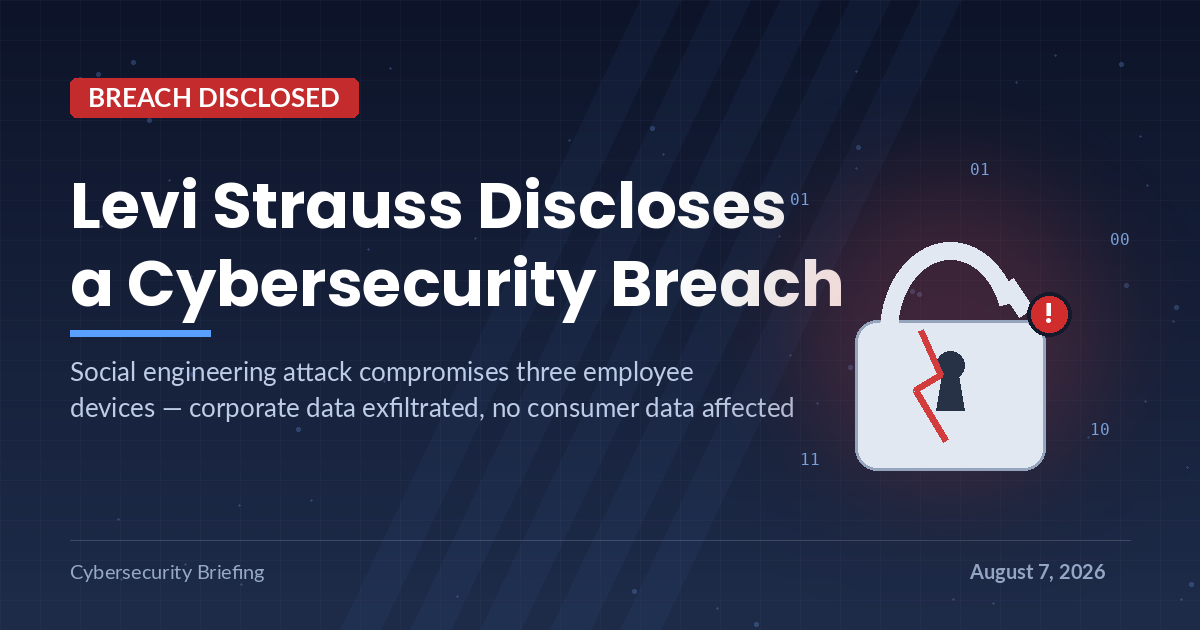
In August 2026, Levi Strauss & Co. disclosed a cybersecurity incident in which attackers gained unauthorized access to internal systems through a social engineering attack targeting three employees. Rather than exploiting a software vulnerability, the attackers manipulated human behavior to obtain access, highlighting the growing trend of identity-based attacks.
The Levi breach has highlighted a growing challenge for modern organizations: attackers are increasingly targeting people rather than exploiting software vulnerabilities. Levi Strauss disclosed that attackers gained unauthorized access to internal systems through a social engineering attack targeting three employees. The incident demonstrates how convincing social engineering techniques can bypass traditional security controls and reinforces the importance of phishing-resistant MFA, least-privilege access, continuous identity monitoring, and effective security awareness programs.
This incident reinforces a critical cybersecurity lesson: people remain one of the most targeted attack surfaces, making identity security and employee awareness just as important as technical defenses.
Organization
- Company: Levi Strauss & Co.
- Industry: Apparel & Retail
- Incident Type: Social Engineering
- Initial Access: Employee-targeted attack
- Primary Target: Internal corporate systems
- Disclosure: August 2026
Levi Breach: What Happened? – Attack Overview
The attackers successfully convinced three employees to perform actions that granted unauthorized access to internal systems. While specific technical details have not been publicly disclosed, the incident aligns with modern social engineering techniques such as:
- Phishing emails
- Voice phishing (Vishing)
- SMS phishing (Smishing)
- MFA fatigue attacks
- Fake IT support requests
- Credential harvesting portals
Unlike traditional cyberattacks that exploit software flaws, social engineering exploits trust, urgency, and human psychology.
Attack Lifecycle (MITRE ATT&CK Mapping)
| Attack Stage | Technique |
|---|---|
| Initial Access | Phishing / Social Engineering |
| Credential Access | Credential Theft |
| Defense Evasion | Use of legitimate credentials |
| Discovery | Internal reconnaissance |
| Lateral Movement | Potential movement across internal systems |
| Collection | Access to sensitive corporate information |
Root Cause Analysis
The breach demonstrates that strong infrastructure alone cannot prevent attacks if users can be manipulated.
Possible contributing factors include:
- Employees trusted fraudulent communications.
- Identity verification procedures were insufficient.
- Weak phishing detection.
- Lack of phishing-resistant authentication.
- Excessive user privileges.
- Inadequate monitoring of identity-related events.
Security Impact
Although Levi Strauss has not disclosed the full technical impact, identity-based attacks can potentially lead to:
- Unauthorized access to internal applications
- Theft of confidential business information
- Exposure of employee data
- Financial fraud
- Business disruption
- Regulatory investigations
- Brand reputation damage
Security Lessons Learned
1. Humans Are the Primary Attack Surface
Modern attackers increasingly bypass firewalls and endpoint security by targeting employees directly.
Organizations should invest equally in:
- Security awareness
- Technical controls
- Identity protection
2. Traditional MFA Is No Longer Enough
SMS and push-based MFA remain vulnerable to phishing and MFA fatigue attacks.
Recommended alternatives include:
- FIDO2 Security Keys
- Passkeys
- WebAuthn Authentication
These methods are resistant to credential phishing.
3. Enforce Least Privilege
Employees should have access only to the resources required for their role.
Benefits include:
- Reduced lateral movement
- Lower data exposure
- Smaller attack surface
4. Continuous Identity Monitoring
Organizations should continuously monitor for:
- Impossible travel events
- New device registrations
- Privilege escalation
- Abnormal login times
- Multiple failed authentication attempts
- Geographic anomalies
Identity should be treated as a primary security perimeter.
5. Security Awareness Must Be Continuous
Annual training is insufficient.
Organizations should conduct:
- Monthly phishing simulations
- Role-based security training
- Executive phishing exercises
- Incident reporting drills
Recommended Security Controls
| Control | Priority |
|---|---|
| Phishing-resistant MFA (FIDO2/WebAuthn) | Critical |
| Security Awareness Training | High |
| Phishing Simulations | High |
| Least Privilege Access | High |
| Privileged Access Management (PAM) | High |
| Identity Threat Detection & Response (ITDR) | High |
| Continuous Login Monitoring | High |
| Zero Trust Architecture | High |
| Endpoint Detection & Response (EDR) | Medium |
| Security Information and Event Management (SIEM) | Medium |
Alignment with Security Frameworks
NIST Cybersecurity Framework (CSF 2.0)
- Govern: Identity governance
- Protect: MFA, awareness training, least privilege
- Detect: Identity monitoring and SIEM
- Respond: Incident response procedures
- Recover: Business continuity and recovery planning
PCI DSS v4.0.1
Relevant requirements include:
- Strong authentication mechanisms
- Multi-factor authentication
- Access control
- Logging and monitoring
- Security awareness program
- User account management
ISO/IEC 27001:2022
Relevant controls include:
- Identity and access management
- Authentication information
- Information security awareness
- Logging and monitoring
- Access restrictions
- Incident management
Action Plan for Security Teams
Following incidents like this, organizations should:
- Deploy phishing-resistant MFA across all critical systems.
- Conduct regular phishing simulations and targeted awareness training.
- Review privileged accounts and remove unnecessary access.
- Enable continuous monitoring for identity-related anomalies.
- Implement Zero Trust principles with conditional access policies.
- Centralize authentication logs into a SIEM for real-time detection.
- Develop and test incident response playbooks for credential compromise and phishing attacks.
- Periodically review access rights to ensure adherence to least privilege.
Key Takeaways
- Attackers increasingly exploit people rather than software vulnerabilities.
- Identity has become the new security perimeter.
- Phishing-resistant MFA provides significantly stronger protection than traditional SMS or push-based methods.
- Continuous user awareness and identity monitoring are essential components of a modern security strategy.
- Combining technical safeguards with ongoing employee education creates a more resilient defense against social engineering.
Conclusion
The Levi Strauss cybersecurity breach illustrates a broader shift in the threat landscape: attackers are prioritizing human-centric attacks over exploiting technical vulnerabilities. Organizations that focus solely on patch management and perimeter defenses may still be vulnerable if identity security and user awareness are overlooked.
A defense-in-depth strategy that combines phishing-resistant authentication, least privilege, continuous monitoring, and a mature security awareness program is essential to reducing the risk of similar incidents and strengthening organizational resilience against evolving cyber threats.